Showing posts with label battle. Show all posts

Monday, July 28, 2014

July 28 - 100 Years Since the Outbreak of WWI

July 28 marks the 100th anniversary of the start of World War One. This is the date when the first declaration of war happened - launching further declarations by others nations.

You can read more about it HERE, but suffice it to say that the assassination of an Austro-Hungarian prince by a Serb nationalist in June 1914 led to a declaration of war by Austria-Hugary against Serbia on July 28, 1914. This is the trigger that set off the other declarations - Russia backing Serbia by alliance, Germany backing Austria-Hungary by alliance and so forth and so on all across Europe.

By early August 1914 the fighting had started and would not stop until late 1918.

The United States didn't get into the conflict until 1917. More on why we waited and what our entry meant to the war HERE.

In 1994, I was in France and went to a battlefield were the US Marines fought the Germans in a famous battle toward the end of the war. The pace is called Belleau Wood. We won.

On this anniversary, I thought I'd post some pictures I took when there.

Immediately below is a historic drawing of the battle. Below that are pictures I took during my visit.

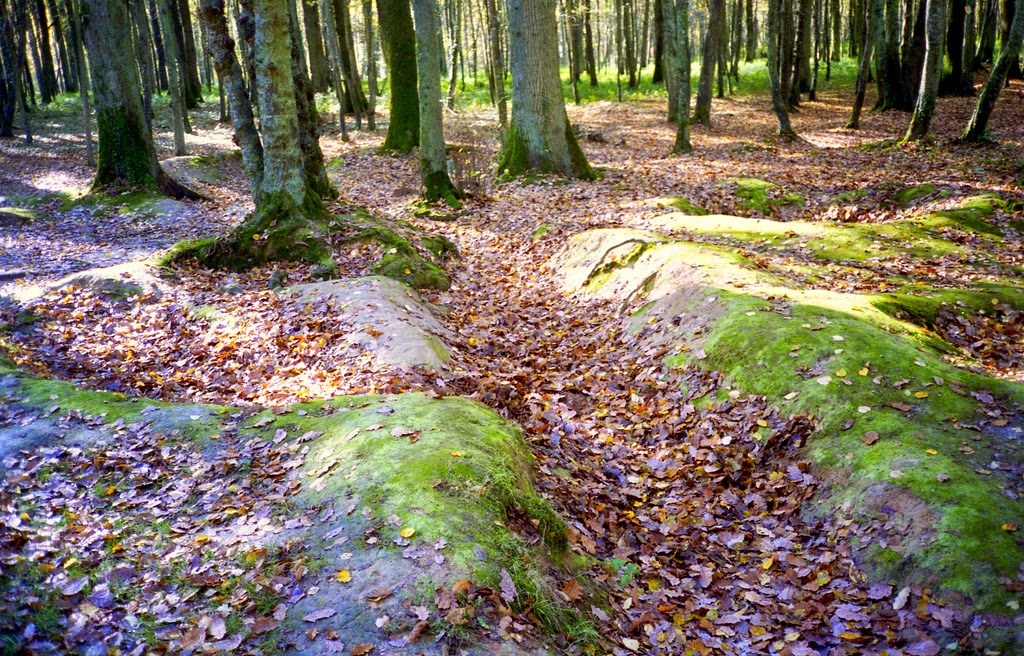
Remnants of a German Trench at Belleau Wood Battlefield, (C) Marc Osborn
WWI Artillery at the Belleau Wood Battlefield, (C) Marc Osborn
Memorial at Belleau Wood American Cemetery, (C) Marc Osborn

NOTE: Copyright for all photographs in this post is owned by Marc Osborn. No use of any of these pictures for any purpose is permitted without the prior written permission of Marc Osborn.


Thursday, June 6, 2013

June 6 - 69th Anniversary of D-Day Landings in Normandy, France

Today marks the 69th anniversary of the Allied D-Day landings in Normandy, France. While there were other major battles that preceded and followed this one on all fronts of the war, this particular day was monumental in turning the tide in the European war against Germany because it opened up a major western front that began the squeeze on Nazi forces from the west by the U.S., Britain, Canada and free French forces and from the east by the Soviet Union's Red Army.

In 1994, I went to Normandy and visited many of the major sites of the D-Day battle just after the 50th anniversary. Below are three shots I took while there. More can be seen on my Flick Photostream HERE.

Omaha Beach
This is Omaha beach where U.S. Army forces landed. I took this shot standing at the water's edge looking back up at the beach and the cliff above. Imagine having to charge across this expanse littered with iron obstacles put there by the Germans and unrelenting machine gun and mortar fire. All round you, fellow soldiers lay dead or wounded while others scramble for cover. Eventually on June 6, forces here overcame the German defenses and moved in land.

Sainte Mere Eglise

The next shot is the church and town square of the village of Sainte Mere Eglise. This is a town behind the landing beaches that the U.S. 82nd Airborne division was charged with securing following their early morning jump into France. However, airborne forces were scattered all over the area, and many came down directly into the town where Germans were waiting. If you've ever seen the movie The Longest Day, this battle is depicted in one of the sequences in the film.


Point Du Hoc
The third shot here is Point du Hoc. This is where U.S. Army Rangers came in by small boat, scaled the steep cliffs under German fire and secured the area so the Germans could not fire down onto the main landing beaches. Again in the move The Longest Day, you can see this battle sequence dramatized.


All pictures in this post were taken by Marc Osborn. Marc Osborn owns the copyright for this images and no use of them for any purpose is permitted without prior written permission from Marc Osborn.


Monday, June 6, 2011

D-Day Anniversary - How To Learn Some More

Today is the 67th anniversary of the D-Day landings in Normandy France on June 6, 1944.

The landings were conducted by the Allies - the U.S., the U.K., France, Poland, Netherlands and others fighting the Germans in World War II.

Here are three ways to learn more about this major, major turning point in the history of the world...

MOVIES
  • The Longest Day - a massive film from the 1960s featuring a whole constellation of stars, this movie definitely is a "Hollywood" production. However, it's well acted and communicates the broad sweep of the events of D-Day through the various vignettes that skip between overall strategy, individual personal stories, from the German perspective, from the British and American perspective and more.
  • Saving Private Ryan - starring Tom Hanks, this modern film tells the story of one mission that took place during the events of D-Day. Through the telling of the story of one little group of soldier's mission to find one man among the armies fighting in Normandy, you get a sense of what happened at the D-Day landings and after.
BOOK
  • D-Day by Steven Ambrose. While the focus here is virtually only on the U.S. participation in D-Day, it is a first class telling of the history from both the high level and personal level. Very readable.
PHOTOS
  • There are loads of photos online about the D-Day landings, both vintage from the time of the invasion as well as newer ones taken many years later. So, check them out to see what things looked like (or look like now) where the battles were fought. One suggestion is a set of pictures I took on a visit to the D-Day beaches and other battle sites in 1994. You can see those by clicking HERE.

Thursday, September 17, 2009

Know Your History: 65th Anniversary of Market Garden

Today is the 65th anniversary of the start of Operation Market-Garden

Don't know what that was? Want to know why you should care?

Well, let me tell you.

To summarize, Market Garden was a massive campaign by the Americans and British to try and end World War II by Christmas 1944. Kicking off on Sept. 17, 1944 the goal was to drop thousands of paratroopers behind German lines in Holland to pave the way for Allied ground forces to advance across that country and directly into Germany. How this operation happened is both a testament to courage, but also has lessons for today.

If you've read the book or seen the movie "A Bridge Too Far" you know this story. Skip the background info immediately below and move on to a couple of my pictures and observations.

If you don't know the story, stick with me for a moment and read the background first as it's relevant to the observations below.

Background
The paratroopers were the "Market" portion of the operation. Their objective was to land behind the lines and capture a series of bridges over rivers and canals so that the "Garden" ground forces could advance across them. At the time the operation was planned, German forces were reeling backwards toward Germany in the aftermath of D-Day in June. Allied leadership felt that this was a perfect time to strike and, despite receiving some information to the contrary, simply assumed that opposition would be light. These were calculations they would regret.

The American 101st Airborne Division landed near the town of Eindhoven and took bridges in that area. The American 82nd Airborne Division landed near the city of Nijmegen (also the city where rock star Eddie Van Halen would later grow up by the way) and took several major bridges there - in particular the Nijmengen Bridge witch they captured in dramatic fashion by crossing the Waal River in little hand paddled boats and under fire. (Above: A picture of the Nijmegen Bridge that I took in 1994)

The British airborne forces dropped near the town of Arnhem, quickly moved into the city and secured the last and final key bridge of the operation there - the one across the Rhine. They were reinforced by Polish paratroops. (Below: A picture of the Arnhem Bridge I took in 1994)

Meanwhile, the British Garden ground forces had advanced over the other bridges secured by the Americans and had nearly reached Arnhem. But, German forces all along the route across Holland, and in particular near Arnhem, were significantly stronger than anticipated and ultimately after nine days of fighting the British had to withdraw from Arnhem. With the failure to capture and hold this last bridge, the overall operation failed in that the Allies couldn't cross the Rhine River and move on into Germany despite having captured a lot of enemy territory. And this is where the title of the book, the movie and the saying, "A Bridge Too Far" comes from. The war went on for another seven months.

Observations
OK, so...why remember this anniversary? Two reasons:

First and foremost, this was a HUGE operation that did help win the war overall despite failing in its own objectives. This success was not gained without loss of life. It is estimated that the Allies suffered 15,000-17,000 casualties in Operation Market Garden. So for those people's sacrifice alone I think it's worth taking a moment to remember the day they set off for their ultimate journey to defend freedom.

Second, I think that lessons of history are hard learned and this anniversary offers a reminder. One of the major reasons that Market Garden didn't fully succeed was faulty assumptions about the enemy and a willingness to look the other way when presented with info that might delay or cancel the operation. Sound familiar? It ought to given how we got into Iraq. So, my point here is that it is worth remembering the anniversary of Market Garden as a cautionary tale about over-excitement to enact military operations...even to the degree of ignoring significant danger signs or dismissing intelligence that suggests other actions would be better.

Wednesday, May 20, 2009

Pictures for Memorial Day & D-Day Anniversary

With Memorial Day coming on May 25 and the 65th Anniversary of the D-Day landings in France coming up on June 6, I've posted a set of appropriate pictures to my Flickr Photostream. 

Click here to see the set.

Included are pictures I took while visiting the Normandy coast in the fall of 1994. On that trip I visited Omaha Beach and Utah Beach where Americans landed, as well as Point du Hoc where U.S. Rangers scaled the cliffs, killed Germans and took out a series of cannons. 

Also included are some pictures of other American battlefields I've visited - including the bridge at Nijmegen in Holland, as well as Belleau Wood (World War I) and Yorktown (Revolutionary War). (Left: Point du Hoc - Normandy, France)

I've also thrown in some pictures of Pegasus Bridge where British paratroopers landed in gliders and took the span on D-Day. And, I've put in an image of Arnhem bridge in Holland where those same British paratroopers fought it out with Germans a few months later.