Showing posts with label U.S.. Show all posts

Wednesday, March 5, 2014

Glasgow to Seattle - Glasvegas Live in "The Emerald City" Once More

Glasgow is a long way from Seattle. Geographically.

In other ways, however, they ain't so far apart. Perceived to be cold, gray, depressing and spawning very good musical acts are among the common traits the two cities share.

So perhaps it is not too surprising that Glasgow-based band Glasvegas has, over the years, come to Seattle four times to play live gigs. Ventures to the States by the group are not too common, but four times in Seattle between Jan. 2009 and Feb. 2014 is a pretty good clip. Perhaps they feel a bit at home here. Hey, even their poster is gray.

It just so happens that Glasvegas is one of my favorite bands of recent years and I've been lucky enough to see each of those four performances in Seattle - including last Friday at the Columbia City Theater. You can read my reviews of two of those HERE (2009) and HERE (2011). You can also see the band perform a song on CBS's Late Night with Craig Ferguson in the early morning hours of March 5 by clicking HERE.

Now, the location for this Feb. 2014 show in Seattle was a bit of a change up for the size of venue most bands like Glasvegas play in. Indeed, most groups with their status play at a joint like Neumo's (as Glasvegas did itself twice) or maybe the Showbox Market. But for whatever reason, this time around they were booked in at the smaller and more out of the way CCT. Other than a bit longer of a drive from my Ballard-area home to get there, the size and location turned out to be great. A very good band, up close and personal in a smaller space that sounded good. Oh, and in case you haven't been there in a while, the Columbia City neighborhood has - for better or worse - filled in now with a bunch of good restaurants, pubs and boutique shops.

Below is my review of the evening - before, during and after the gig:

Before the Show
A buddy and I hit one of those restaurants before the show, an Italian place called La Medusa. Good food people! Next, we walked the block up to the theater to see what was happening around there only to run right into Glasvegas bassist Paul Donoghue outside having a cigarette. We said hello, thanked him for coming all the way to Seattle and he told us that they almost hadn't made it because they were driving in from Minnesota across the north of the USA and got caught in a blizzard. He said that they only pulled into the parking lot of the theater at about 5:30 p.m. Wow.

We thanked Paul again and went inside. Not much happening in the bar. We pushed on into the theater and saw that the opening band, The Ceremonies, was on stage performing. We knew it'd be about an hour before Glasvegas came on and we decided to go back out and check out a pub we'd walked past on the way. We had a pint, talked about whatever and after a while decided it was time to go back.

Our arrival back at the theater was well timed as it was probably only 10-15 minutes until it was "Glasvegas time." We re-entered the performance space and made our way down about halfway to the stage...which in this venue is still really close to the stage. From the balcony/runway that runs above and along one side of the theater, four darkly dressed figures strolled toward the stage above us and then sauntered out front stage center.

The Gig

The band quickly kicked into the first song from their new album, a number called "Later...When the TV Turns to Static." See my review of the full album, also of that name, HERE. From there, Glasvegas launched into a 90 minute set featuring songs taken from their three albums with an emphasis, of course, on material from their most recent release.
Glasvegas on stage in Seattle at the Columbia City Theater - Feb. 28, 2014
Interestingly, main man James Allan was back to wearing black - donning a black leather motorcycle jacket and black trousers. The rest of the band wore their usual black attire. On their last our, he reversed his normal color choice and wore all white - I think as a comment on the generally positive tone and outlook of their second album, Euphoric Heartbreak.

Since this was a small venue, the band was right there up close. As a consequence, the time between songs lent itself to a more natural opportunity for lead man James Allan to converse, joke and say things to the audience - which he happily did.

This is an element of the Glasvegas - and perhaps James himself - persona that has grown and matured over the years. In their first two shows of theirs that I saw, the stance was not to talk to the audience at all...just go on, play the songs (and they did that well) and not say anything to the audience. Good but not too endearing. I like a band or a performer who is confident and willing to engage an audience as it shows they care about their fans and makes the performance more customized or unique. Well, no problem with that at this show. Allan talked to the audience between almost all the songs.

Beyond thank yous to the audience and saying names of songs, some of the banter that I recall included:
  • Allan asking the house lighting operator to dim the lights down because he thought they were too bright and not appropriate for the mood they were going for. This inspired a bit of light hearted back and forth with the audience too.
  • An introduction by Allan to the song "Lonesome Swan" in which we learned that the lyrics were, in part, inspired by a visit by Allan to a park lake somewhere that had those animal shaped paddle boats for rent. Apparently, when he was there, all the boats were out except one shaped like a swan...making it a lonesome swan. This got Allan thinking and produced a really good song...not literally about a paddle boat mind you.
  • At one point, Allan decided to take off his probably now very hot black leather jacket. But, before he did he asked the audience if they could identify the face of the person stenciled in white on the lower front portion of the jacket. To me, it looked like Jerry Garcia or Greg Almond. To be honest, I did not hear what James said when he told the name...both because of the crowd noise and his thick Scottish accent. I think he said, "Jerry Allan." A relative? I could be and probably am wrong.
  • Between one of the songs, Allan bent down to high five or grab hands with a few of the fans right up front. Apparently one of them must have put out a fist in anticipation of a reciprocal fist bump from Allan. After standing up, Allan told the crowd about how that prior to this very tour in the US, he had no idea what a fist bump was. He said that earlier in the tour someone stuck their fist out and he had no idea what to do with it...oddly grabbing and shaking it like a normal hand shake. Now, of course, he knows.
Overall, I would say the performance was top notch. The band were into the gig, giving their performance
Allan and Donoghue on stage in Seattle
with energy and effort - James Allan pacing the middle of the stage and singing out loud and strong, Rab Allan making the most of his stage right space, drummer Jonna Lofgren bashing her drum kit from her normal standing position and Paul Donoghue holding down the fort on bass over at stage left. The sound was really good in this small but acoustically excellent space and, as mentioned, the lighting and effects were minimal...which worked well in this case.

After performing their set and a short break before an encore, Glasvegas ended the show with a stonking version of their tune "Lots Sometimes." This is a song that starts slow and picks up pace steadily to the point where the last, say, third of the song is rocking loud and fast. An excellent way to end the show on a high, rocking note!

Below is a list of songs I recall them playing in total. I think I've captured them all here, but the ordering of them is rough based on a one week old memory. For sure the opener and closer are in the correct order:

Later...When the TV Turns To Static
Youngblood
Lonesome Swan
Geraldine
Dream, Dream, Dreaming
Ice Cream Van
If
The World Is Yours
It's My Own Cheating Heart That Makes Me Cry
All I Want Is My Baby
Go Square Go
----------------------------------------
Choices
Daddy's Gone
Lots Sometimes

Saying Hi to the Band After
And with that, the band exited the way they came in...up the stairs and across the elevated balcony above the stage on the wall. Most of the crowd filtered out, but I had seen a small sign saying that the band would be out to greet fans and sign merchandise after the show. My buddy and I decided to cool our heels in the bar for a bit and then see if we could say hello to Glasvegas after a bit. This we did successfully and were able to speak directly with each member of the band. My feeling on these type of things is that I would rather actually talk with a band member than ask them to sign something for me as my interaction with them. The later seems very self-serving and limits any communication around a physical object rather than something you might say or learn. So, as usual, I did not bring anything for band members to sign.

To James Allan, I wanted to let him know that as an older fan of rock and roll, I really appreciated what he and his band were doing and that it gave me hope for rock...and I did tell him that after thanking him for the show and for coming all the way to Seattle. He greeted my statement with a quick wide-eyed look and a big hug for both me and my friend. You could tell he really appreciated it. A sweet gesture of thanks.

For Rab Allan, we told him we had been to each of the four Seattle gigs for Glasvegas. He asked us which ones we liked best and said he thought the one on this night and their very first show in Seattle at Chop Suey were the best.

With Joanna Lofgren and band manager Denise (also James Allan's sister), we received confirmation that the band had indeed been stuck in a blizzard on their drive from Minneapolis to Seattle - to the degree that they had to pull off the road and wait it out. Lofgren said she did take a short walk around the neighborhood before the show, but did not get to enjoy what she had heard was a very nice day in Seattle. We assured her that Vancouver, BC - their next stop - was a great city and wished her a chance to get out and about up there to see some of the northwest.

Since we'd already spoken to Donoghue, and because it was getting late, we called it a night. With a quick tap on James's shoulder on our way out as a final thank you...we took off into the night and home.

Glasvegas continued on their U.S. tour, heading first north...then Portland and California. Will they be back soon - with new music or a tour? I hope so. This is a band that continues to grown and do interesting things. And, they're nice people to boot. So...here's hoping they keep on doing what they're doing and we get a chance to see them again in the not too distant future.

NOTE: Photographs of Glasvegas on stage in this blog post were taken by Marc Osborn. Copyright for those pictures is owned by Marc Osborn and now use of the images for any purpose is permitted without prior written permission from Marc Osborn.


Thursday, June 6, 2013

June 6 - 69th Anniversary of D-Day Landings in Normandy, France

Today marks the 69th anniversary of the Allied D-Day landings in Normandy, France. While there were other major battles that preceded and followed this one on all fronts of the war, this particular day was monumental in turning the tide in the European war against Germany because it opened up a major western front that began the squeeze on Nazi forces from the west by the U.S., Britain, Canada and free French forces and from the east by the Soviet Union's Red Army.

In 1994, I went to Normandy and visited many of the major sites of the D-Day battle just after the 50th anniversary. Below are three shots I took while there. More can be seen on my Flick Photostream HERE.

Omaha Beach
This is Omaha beach where U.S. Army forces landed. I took this shot standing at the water's edge looking back up at the beach and the cliff above. Imagine having to charge across this expanse littered with iron obstacles put there by the Germans and unrelenting machine gun and mortar fire. All round you, fellow soldiers lay dead or wounded while others scramble for cover. Eventually on June 6, forces here overcame the German defenses and moved in land.

Sainte Mere Eglise

The next shot is the church and town square of the village of Sainte Mere Eglise. This is a town behind the landing beaches that the U.S. 82nd Airborne division was charged with securing following their early morning jump into France. However, airborne forces were scattered all over the area, and many came down directly into the town where Germans were waiting. If you've ever seen the movie The Longest Day, this battle is depicted in one of the sequences in the film.


Point Du Hoc
The third shot here is Point du Hoc. This is where U.S. Army Rangers came in by small boat, scaled the steep cliffs under German fire and secured the area so the Germans could not fire down onto the main landing beaches. Again in the move The Longest Day, you can see this battle sequence dramatized.


All pictures in this post were taken by Marc Osborn. Marc Osborn owns the copyright for this images and no use of them for any purpose is permitted without prior written permission from Marc Osborn.


Thursday, July 12, 2012

Nothing More American than US Olympic Uniforms Made in China

Turns out that the 2012 U.S. Olympic team uniforms are made in China. Yep. China.

This has, of course, created some outrage and generally appall about how our team's duds are manufactured overseas...and in a communist country to boot.

Well, my opinion is...grow up, there is nothing more American in 2012 than products for the U.S. produced in China. After all, our nation's government, business sector and citizenry have gone out of their way to make that possible. For example...

  • Cheap labor. U.S. businesses want it to pad profit margins and "create efficiencies," so they lay off American workers and ship jobs overseas. Like to China. 
  • Avoiding regulation. Business wants that too. After all, worrying about environmental impacts of manufacturing, safety standards and work hours for workers are costly...but not in China. 
  • Government complicity. Whether it's passively sitting by and watching U.S. businesses move jobs overseas (I mean you Democratic Party) OR actually encouraging it through tax breaks and trade agreements (I'm looking mainly at you Republican Party, but Democrats are not immune)...our government has made it real easy for corporations to move manufacturing to places like China. 
  • Cheap products. US consumers want them and clamor to their local WalMart and other such places to get them...but that stuff on those shelves ain't made here in the USA people. The culture of "gimmie cheap" regardless of quality or impact to U.S. jobs by the American consumer is part of the problem. Now, one complicating factor is that the issues raised in the above bullet points have also created a shitty U.S. economy, thus propelling demand for cheap products from "want to have" into virtually "need to have" status for average Americans. Think that's a coincidence? I don't.
  • American voters. Fueled and fooled by vague notions of "freedom," "family values," and "small government," a large percentage of U.S. voters keep returning the very politicians to power who create or allow all of the above to happen. 
So, are you pissed off that the U.S. Olympic team uniforms are made in China? That really get under your red, white and blue skin? 

Well, do something about it then. Or shut the F up. 

Think about who you vote for, the ideas you support and what those choices mean for U.S. jobs. Think about buying made in the USA products...literally put your money where your mouth is. Don't like US made goods or think they are too expensive? Then shut up about the issue. And think about getting pissed off at corporations and not "the government" or China.


Friday, June 10, 2011

Why the U.S. Cares About Yemen

Ever wonder why we here in the U.S. should care about Yemen?

You know, Yemen? Yeah, me too...never would have thought about the place until recently.

But here are three things to consider in order to get to the answer of why our country cares about Yemen and uses our military to intervene there...
  • First, think about how dependent on oil our economy is, and how much of that oil comes from the Middle East.
  • Second, think about how that oil gets from the middle east (by ship) and where it has to go to get to us.
  • Then third, look at this map...


That's right. Yemen sits there at the opening of the Red Sea...a major waterway up to the Suez Canal, the Mediterranean and onto the Atlantic. Or, going the other direction, it sits there right at the gap leading from the Red Sea into the Indian Ocean and Pacific. Either way you are shipping oil by ship, you're more than likely to need to go through that gap. Control that gap, you control the flow of oil shipping. You don't control that gap because of a rouge regime or anarchy? Well, could be problems gassing up you Escalade.

Monday, June 6, 2011

D-Day Anniversary - How To Learn Some More

Today is the 67th anniversary of the D-Day landings in Normandy France on June 6, 1944.

The landings were conducted by the Allies - the U.S., the U.K., France, Poland, Netherlands and others fighting the Germans in World War II.

Here are three ways to learn more about this major, major turning point in the history of the world...

MOVIES
  • The Longest Day - a massive film from the 1960s featuring a whole constellation of stars, this movie definitely is a "Hollywood" production. However, it's well acted and communicates the broad sweep of the events of D-Day through the various vignettes that skip between overall strategy, individual personal stories, from the German perspective, from the British and American perspective and more.
  • Saving Private Ryan - starring Tom Hanks, this modern film tells the story of one mission that took place during the events of D-Day. Through the telling of the story of one little group of soldier's mission to find one man among the armies fighting in Normandy, you get a sense of what happened at the D-Day landings and after.
BOOK
  • D-Day by Steven Ambrose. While the focus here is virtually only on the U.S. participation in D-Day, it is a first class telling of the history from both the high level and personal level. Very readable.
PHOTOS
  • There are loads of photos online about the D-Day landings, both vintage from the time of the invasion as well as newer ones taken many years later. So, check them out to see what things looked like (or look like now) where the battles were fought. One suggestion is a set of pictures I took on a visit to the D-Day beaches and other battle sites in 1994. You can see those by clicking HERE.

Tuesday, April 12, 2011

150 Year Anniversary of the U.S. Civil War - Something to Remember

Today is the 150th anniversary of the start of the Civil War in the United States. You'll probably see some media coverage about this on CNN and other cable news outlets and other places. I've also seen that PBS is running the Ken Burns documentary on the conflict this week too.

But as you read, listen or watch about this war, there is one thing to remember - the South started it, did so to preserve their slave-based economy and they lost the war.

All of these may seem obvious to the casual observer, but it's not so obvious to some - especially in the South.

For example, you will hear some people say things like:
  • Able Lincoln started the war by "forcing" the South to take up hostilities
  • The war was not about slavery...it was about state's rights and the control of the Federal government
  • The South didn't really lose the war more than they just stopped fighting

I have heard each of these positions articulated in the U.S. South within the last two years. All of this is simple ignorance at best and revisionist history at worst. And, according to recent research, nearly one quarter of American sympathize with the Southern states that were part of the Confederacy and more than 4-in-10 say slavery was not the reason for the Civil War.

But, let the facts speak to the history:

The South started the war. They did. It's a fact. Look it up. The. South. Started. The. War. Period. Upon Lincoln's election in Nov. 1860, South Carolina left the Union. Within three months six other Southern states followed and formed The Confederate States of America. At his inauguration, Lincoln called the Southern secession as "legally void,"but he did not threaten hostilities nor did he advocate eliminating slavery where it already existed. None the less, on April 12, 1861 Confederate forces fired cannons on the U.S. Army garrison holed up in Fort Sumter out in Charleston bay. And from then, the war was on. Claims that somehow Lincoln was to blame are simply bogus. The South wanted out of the Union and would not hear of any other solution...to the degree of starting the war over it. (Above: Fort Sumter. Photo by Marc Osborn)

It was about slavery. The South seceded from the Union and started the war because leaders and wealthy in the southern states felt the very foundation of their economy - slave labor - was under threat by the growing abolitionist movement, emerging Federal law and issues over slavery in new states admitted to the Union. No matter what other issue bitter Southerners can conjure up as the "real" reason for the start of the war - sectionalism, tariffs, state's rights, etc. - the are all are based on the fear of losing slave labor in the Southern economy. It's that simple people. (Right: Slave market building in Charleston, SC. Photo by Marc Osborn) 

The South lost the war. They were beaten and surrendered. Southern Gen. Robert E. Lee's surrender to Union forces under Gen. U.S. Grant in Virginia gets the most play in history, but the South's surrender was actually a series of surrenders by defeated Confederate armies all across the South. While the South initially put up a good fight and had the North on the ropes early in the war, ultimately the industrial power of the North combined with its greater population and economic power overcame Southern successes with the U.S. Army and Navy defeat the South on the field of battle. Based on their inability to sustain their forces and win battles, the Southern armies surrendered in 1865. After nearly four years of war and more than 600,000 dead or wounded, the war was over.

So why care about this today on the 150th anniversary of the start of the war? Why clarify it? Two main reasons:

1) These issues continued to plague the U.S. after the war in the form of civil rights issues and economic development. And, race to this day is still an issue in our country, and prior to the 1960s and civil rights legislation, the status quo down South - while not slavery - was extremely prejudice against people of color. To understand our race issues today, you need to understand why the Civil War started and ended at least at a basic level. Otherwise, you're just spouting off without knowing what you are talking about.

2) Because today a lot of people don't know the above and/or refuse to acknowledge it. This fuels their fantasies about "nullification" or "states rights." Think about those stats I referenced earlier in this post. Right now, we've got a quarter of our population sympathizing with the Confederacy and nearly half thinking slavery was not the primary reason for the war. Hey, if you believe the South was "forced" into the Civil War, was fighting to defend "state's rights," and that they didn't lose as much as stop fighting...then you might be someone who today hates the Federal government and regulation of any kind, still harbor racist attitudes and resents the rest of the nation that is economically better off. Sound familiar?


NOTE: Photos in this article are taken by Marc Osborn and are not authorized for any use without prior written permission from Marc Osborn.


Wednesday, February 23, 2011

Is U.S. Wealth Inequality Linked to Poor Comparison to Other Countries?

There were two charts that caught my eye this week.

One shows the unequal distribution of wealth in the U.S. such that the very tippy top percentile of citizens control huge amounts of the money in our economy and society. See it HERE.

The other shows how the good old USA is by no means "the best" at everything compared to other modern, industrialized nations that most Americans just assume we're better than. See it HERE.

However, I was thinking that these two graphs probably are correlated. As in, the inequity of wealth pooled in the bank acounts of a small number of people may indeed correlate to the poor performance of the U.S. vs. other comparable nations when it comes to things like life expectancy, unemployment, student performance, prison population and even how many people who run out of money so they cannot buy food.

Sure, there are some other measures where we probably are #1 like amount of money spent on healthcare vs. relative health of the population, number of gun owners per 100,000, obesity rate, etc. But obviously these are not badges of honor...at least in my opinion.

People like to think that it doesn't get any better than the U.S.A., but if you look at countries such as Canada, Norway, Australia, Germany and other this does not seem to be true. I'm not saying I want to move from the U.S. But, what can we learn from these other nations? What are they doing that we're not? What is it about their societies, priorities and systems that they have a better overall standard of living - at least by the measures in the charts?

Well, that's fodder for another post at another time. But here's one thought I'll shoot out there for consideration...while all those societies are peaceful democracies based on a capitalist economic foundation, the tend to be of a more "we're all in this together" mentality while the U.S. tends to be of a "I got mine, screw you" mentality.

Wednesday, October 20, 2010

A Little Ammo for Those Pre-Election Conversations

With the election coming up in just under two weeks, many people will be making up their minds how they are going to vote. While most probably are not influencable, there may be some people who are even as late as election day itself.

Look, my feeling is that turning the Federal government back over to the very same people who ran our nation into the ground over the past 10 years - and that's what we're talking about when we ponder a change in leadership in Congress - is exactly the wrong thing to do.

From what I can tell, most Americans have the political attention span of a gnat on speed, so many may not remember that virtually every single one of our economic problems were designed, created, manifested and grew to disaster proportions under leadership of the last administration and under conservative rule of Congress.

If you feel the same way, below are a few tips for conversations you may have between now and election day with people who may be leaning towards voting us back to the stone age, but perhaps haven't put too much thought into it yet.
  • Note - if the person you are talking to is firmly convinced, then nothing you say will change his or her mind or make them think any differently than they already do. Ain't gonna happen. You might want to jab a little for fun, but don't expect to change that person's mind.
  • Note - if you are a conservative and reading this, I understand if you disagree. You may want to skim this quick (or just ignore it) and then tune into Fox News for your fix.
OK, here are some tips for potential topics that may come up in your political discussions over the next few days...

THEY SAY:
I'm voting for CANDIDATE X from the Tea Party because we just need to clean house in Congress. Throw the bums out. Send a message.

YOU SAY:
Yeah, things are pretty messed up in DC. That's for sure. But you know, just voting for someone to kick others out may not always be the best thing. I mean, you gotta consider who you are voting for as well. Seems like a lot of the Tea Party candidates have some pretty "out there" ideas like getting rid of Social Security and Medicare. And I'm not even going to get into some of the wackier things some of these Tea Party candidates indulge in (dressing up like a Nazi, being homophobic but collecting rent on a gay nightclub). Just saying, but I'd check out the candidates you're voting for more if I were you.

THEY SAY:
Government is too big. We need to reduce it's size and get it off the backs of Americans. That's how I'm voting.

YOU SAY:
If that's how you feel, I can't see how you'd want to vote Republican. The U.S. federal government grew to its largest size ever in terms of spending and number of people employed during the six years when Republicans ran the entire show - President and Congress Do you really want to hand over control of the government back to the people who made it so big?

THEY SAY:
I'm voting for fiscal responsibility. Our budget deficit is going to kill our economy and our childrens' future.

YOU SAY:
Yes, I agree 100 percent. I also agree that getting the budget balanced and back into the black is the right thing to do. I assume then, that you'll be voting Democrat, right? I mean...hey, lets face facts. The record budget deficits we now have are a direct result of Republican leadership over the past decade and longer. Reduced taxes for the wealthy and big business, massive deregulation of markets, free trade policies, along with increased government spending and financing two wars are all key moves made by Republican Congresses and the Bush White House. We're still trying to dig out from that. You want to give them control again? I say no. And hey, guess who led us out of the last debt crisis and into the back - Bill Clinton.

THEY SAY:
I'm voting for the Tea Party because our freedom and liberty are under attack. We need to get those back.
YOU SAY:
I am not sure I understand? The U.S. economy and culture are the freest in the entire world. Just so I know where you're coming from better, what are you now no longer able to do freely that you want back?

THEY SAY:
I'm voting conservative (or Republican or Tea Party) because of (insert moral, religious or "family values" issue here).

YOU SAY:
I can tell you're passionate about this. But, when was the last time a conservative or Republican controlled government actually delivered on your issue - or any moral values issue? Abortion is still legal. We still have firm separation of church and state. Gay marriage is still legal in a number of states and if anything the tide is going towards more of it. Same with assisted suicide. Seems like the Republicans or conservatives use issues like yours to get your vote and then never deliver. You know...they're using you.

NOTE: you are not going to change a person's mind on their moral issue, but you may someone to think twice about voting for the same type of candidates over and over.

THEY SAY:
I am just not seeing the change that I voted for in 2008, so I am not going to vote. It clearly makes no difference.

YOU SAY:
Healthcare reform has been passed, a stimulus to the economy has helped stabilize it and stave off worse unemployment, the auto industry has been saved and we're starting to dial back our presence in Iraq. Sure, there is more to do and no it's not as fast as I'd like either. But, not voting will basically hand the government back over to the very people who wrecked us before. Not a good move in my book.

THEY SAY:
Unemployment is still really high and Obama and Congress have done nothing to fix it.

YOU SAY:
Yeah, I'm disappointed too. But I think it's wrong to blame Obama. I mean, he came into office with high unemployment and an economy just about to go down the tubes. He's done a pretty good job of stabilizing the economy and unemployment rates in under two years.

More important than any of that is the fact that jobs are created by businesses - not the government. To me, it seems like businesses are not innovating to grow - and with it hire people - but rather just finding new ways to lower costs by outsourcing or reducing staff. And, using the recession as an excuse to keep their now lighter employee base small. Maybe it would be good to have a government that encourages domestic innovation and employment.

Sunday, April 4, 2010

Know Your History...Because It's Being Re-Written

To some degree, what is accepted as history is indeed influenced by modern day interpretations. Usually, however, those viewpoints don't tamper with the facts of history...rather, they offer up analysis of what happened in whatever context is relevant at the time.

However, I read a disturbing story today in the Seattle Times about how elements of the conservative right are literally trying to re-write U.S. history to fit their vision of our country as a religious nation that did not and has not ever benefited from government involvement in matters.

It's no small stuff we're talking about here. We're talking about out-and-out change to facts. Not interpretations or opinions, but an insidious re-writing facts to suit a warped and ultimately negative political philosophy. What's disturbing is that these people might just get away with it. For example, your kids or perhaps theirs will come to believe thing such as:
  • Theodore Roosevelt was a socialist.
  • The Federalist Papers did NOT stake out a strong role of the Federal government.
  • Thomas Jefferson was not that important to the founding of the country and his ideas of separation of church and state were not adopted.
  • Franklin Roosevelt caused the Great Depression.
  • Senator Joseph McCarthy was an American hero brought down by lying liberals who smeared his good name.
Think I'm paranoid or kidding? Read the story yourself.


Wednesday, July 29, 2009

Visiting the South - The Series

As many readers of this blog know by now, my wife Diane and I took a trip to the southeast of the U.S. this past spring. Over the past couple months, I've re-capped our adventures in a series of posts - each with the "Visiting the South" title. I've tried to capture not only where we visited, but also added in some observations and perspectives. Hopefully you have found the info interesting, maybe learned something and picked up tips for what to do, see and eat if you ever find yourself in the places we went.

Since my reporting is now wrapped up, I wanted to provide a single post with handy links to the entire "Visiting the South" series. So, just click on the chapter headlines below...

________________________________________________

***VISITING THE SOUTH***


=========================


=========================


_________________________________________________

Thanks again for checking in on the blog.

If interested, you can read the last travel series I wrote about our trip to China in 2008 - a series called The China Reports. Click here to see that.


Thursday, June 4, 2009

Know Your History - Why the Tienanmen Crackdown is Relevant Today

June 4, 2009 marks the 20th anniversary of the Chinese government crack-down on the massive pro-democracy protests that were happening in Tienanmen Square in Beijing.

These events are important to remember and relevant today in my estimation for two reasons:

  1. The violent crack down shows what the Chinese communist government is willing to do if challenged.

  2. The protests led directly to an opening up of the Chinese economy and the resulting boom that has, lets be honest, a HUGE impact on the U.S. and world economy.

Diane and I were in China last year and visited Tienanmen Square. You can see some of the pictures I took while there by clicking here.

In terms of what happened and why it's relevant today, the story goes like this...

In the spring of 1989, students and others filled the huge plaza in central Beijing to protest the controlling government that was presiding over a faltering, iffy economy on top of heavy restrictions on personal freedom, speech and other human rights.

Protesters initially gathered in mid-April to mourn the death of pro-democracy and anti-corruption official Hu Yaobang. Focus of the protest began to crystallize around desire for national democratic reform and greater economic freedoms. The crowd got bigger, louder and more determined...however, it remained a non-violent protest.

All of this happened in a year - 1989 - in which other communist governments had failed (East Germany, Czechoslovakia and Romania for example). With this in mind, and not wanting to lose their grasp on power, the communist government of China decided the protest could last no longer and "cleared" Tienanmen Square with army soldiers and tanks. People died. Lots of them. They were shot, run over and beaten. Many more were jailed or never heard from again. This was a naked power play by the Chinese government to crush dissent. So, we now know what they're willing to do if things come to a critical head again. We also know their army is willing to participate.

However, soon after the end of the protest, the government did something else too. It decided that instead of giving in on controls over speech, rights and democracy...it would greatly loosen economic controls and open up China to free-enterprise and market economies. This enabled the big and enduring economic boom in China that is still happening today.

As a result, today - and believe me it's evident over there - the Chinese are very focused on amassing wealth and material possessions. They are not as concerned over freedom of speech or democracy. Their perspective might be, "I don't mind government control of the media or that I can only vote for one party if I can drive my brand new car from my new high rise condo to my tech job."

Of course other big outcomes of the economic decisions made in the wake of the Tienanmen Square episode have been US companies moving jobs from North America to China for the cheap labor and Chinese ownership of US debt. To me, these are clearly not good developments given our country's inability to balance these moves out with new job creation and fiscal responsibility here.

Monday, November 17, 2008

Of Football, Fans, the Flag and a Guy Named Tits

On Sunday, several buddies and I went to the Seattle Seahawks NFL football game in downtown Seattle. The team is horrible, played pathetically and predictably lost - moving their record to a depressing 2 wins, 8 losses.

However, there was much more going on than just a football game - both around me in the stands and in my own toughts. The game experience really turned into an interesting venue to observe and reflect. Here are a few things that really struck me:

The Flag and the National Anthem
For the first time in a long, long time...participating in the national anthem and all of the patriotic ceremony that goes with that felt really good. With our recent selection for President and the attendant move for change that the majority of Americans voted for, I felt more proud of being a U.S. citizen than I have in quite a while.

I realize that the flag is just a piece of cloth, but it is a symbol...a symbol upon which others around the world and especially U.S. citizens project their notions of what America is. While there are some basics that never change, certainly different eras and circumstances can bring different and sometimes negative feelings to be bound up in the image of the flag. On Sunday, surrounded by the roaring masses of 68,000 fellow citizens, for the first time in a long time my own notions of what the flag stands for...and therefore what our country stands for...were positive.

As it unfurled on the field and flew above the stadium, and as the anthem was sung, I felt that instead of standing for war, deficits, incompetence, big business, oil, pop culture trash, cronyism, ignorance, lobbyists, etc., the flag in my mind stood for hope, change, strength to overcome, a new chance, rebuilding and the unifying power of new possibilities.

The Fans
All I can say is...this ain't baseball. In fact, it isn't college football, the NBA, golf or soccer. No, this is the NFL and fans of NFL teams are a different breed. An NFL game seems to be a place where people can let it all hang out. Every football Sunday is both Halloween and a keg party in which the participants basically freak out for 3-4 hours.

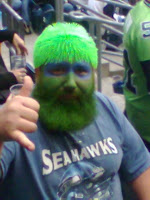
The majority of fans (say, 70%) were, by my estimation, working class, in the 30-50 range in age, white, male, sporting a nicely rounded gut and wearing some form of a Seahawks jersey. These fans are rough around the edges, don't care and will tell you so if you don't like it. And that's here in friendly Seattle. Imagine what fans must be like in Philly or New York. The thing that struck me most was that these people not only were passionate about the Seahawks and the NFL, they seemed to need it, crave it, desire it as an outlet. Amongst that demographic, perhaps in these trying times it all means that much more.

Below (picture taken by Sean Haugen) is one guy who sat right in front of us. He was great...really into the game, boisterous and dressed for the occasion.

Another nearby fan we called "Angry Man." He was white-hot pissed off at all times and screaming...just SCREAMING...his displeasure at what was happening on the field. Funny thing is, unlike most of the other people around us, he looked like a normal middle aged guy.

There was another guy dressed up in pimp gear Yep, a long Seahawk coat and pants, fedora with a big feather plume, flashy tie and shoes and he was carrying a similarly dressed mini-pimp doll. And he was popular. You really can't do anything other than look at that and appreciate. Imagine a stadium filled with people who mostly were like these guys.

Sometimes you are just lucky
Earlier in the game we stopped off at a concession stand to get some beer, and upon returning to our row we set our beverages in the convenient cup holders in front of each of our respective seats.

At one point, the Seahawks actually did make a good play...a really good play. Fans all around us were jumping up and down, screaming and high-fiving. I was too. As the cheering mayhem proceeded, I noticed that all of a sudden my beer "exploded" - foaming over and spilling onto the pavement in front of me. I had no idea what had happened. My first thought was that someone threw something and it had miraculously (and unluckily) landed right in my beer. So, I was kinda mad. I felt around in the beer expecting to extract a golf ball or something, but instead pulled out...MY WEDDING RING!

Somehow, some way...for the first time in 11 years of marriage, my ring came off my finger. More amazing, it landed directly IN MY BEER. Imagine if it had pinged off to one side of the cup or simply flew into a different row. I would never have found it - ever. What are the odds that my ring would rocket off my finger in a moment of flailing around while cheering and would score a DIRECT HIT into my beer cup? Pretty amazing. Suffice it to say, I kept my fist mostly clinched the rest of the game so it didn't happen again. The Seahawks made things easier too by proceeding to stink the rest of the game so there was nothing more to cheer about. But in the end, the two big takeaways on this one are...never underestimate the usefulness of a glass of beer and sometimes you're just lucky.

Some nicknames are good, some are not
Nicknames can be great. I've known guys with monikers such like "Slimer," "Frog Legs" and even "Bean Pod." All were good guys, all fitting nicknames that they embraced. However, some nicknames are clearly NOT good. We became aware of one of them at the game.

A woman in front of us all of a sudden turned around, looked up into the stands and yelled, "Hey tits!!!" Then she waved. When a couple of us laughed, she just said, "Oh, that's my friend up there. His nickname is Tits." Really? A guy? With that nickname? She assured us it was true and that her friend liked it. No more explanation as to how this poor soul got the name or anything. She yelled at him a few more times during the game. "Hey Tits!!!" I felt sorry for the guy...and wondered just what he had to have done - or look like - to get that unfortunate nickname.

So there you go
Renewed patriotism, social observations, bizare nicknames, blind luck and the unlimited value of a full cup of beer - all things I learned during one NFL football game.