Showing posts with label history. Show all posts

Friday, May 25, 2012

Memorial Day 2012

In honor of this weekend's Memorial Day Holiday...

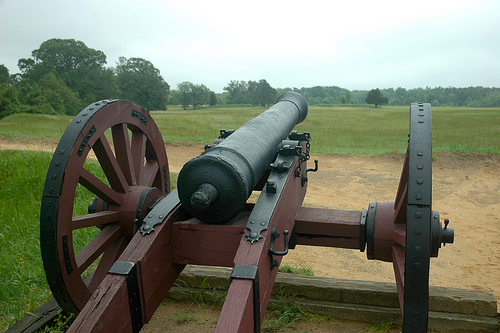
Below are three pictures from a set of shots I've taken over the years at places where members of the U.S. military have sacrificed all. You can see the entire set HERE.


Battlefield at Yorktown, VA
Point du Hoc in Normandy, France


Inside the Citadel in Hue, Vietnam


Sunday, April 4, 2010

Know Your History...Because It's Being Re-Written

To some degree, what is accepted as history is indeed influenced by modern day interpretations. Usually, however, those viewpoints don't tamper with the facts of history...rather, they offer up analysis of what happened in whatever context is relevant at the time.

However, I read a disturbing story today in the Seattle Times about how elements of the conservative right are literally trying to re-write U.S. history to fit their vision of our country as a religious nation that did not and has not ever benefited from government involvement in matters.

It's no small stuff we're talking about here. We're talking about out-and-out change to facts. Not interpretations or opinions, but an insidious re-writing facts to suit a warped and ultimately negative political philosophy. What's disturbing is that these people might just get away with it. For example, your kids or perhaps theirs will come to believe thing such as:
  • Theodore Roosevelt was a socialist.
  • The Federalist Papers did NOT stake out a strong role of the Federal government.
  • Thomas Jefferson was not that important to the founding of the country and his ideas of separation of church and state were not adopted.
  • Franklin Roosevelt caused the Great Depression.
  • Senator Joseph McCarthy was an American hero brought down by lying liberals who smeared his good name.
Think I'm paranoid or kidding? Read the story yourself.


Tuesday, August 18, 2009

Know Your History: Outrage at All Key Times of Change

Almost always, it pays to know your history when trying to judge what's happening in the present. And so it is today.

Think things are getting a little crazy up in here over the current healthcare debate?

Well, if you know your American history you'd know that this ain't the first time. Nope. The truth is, any time there is big change on the agenda in America, the extremists and paranoids come out to play...often spurred on by monied interests wishing to continue their spectacularly good thing and playing to the fears and prejudices of everyday people. It's happened over and over in our history.

Authentic, organic if confused outrage by a sector of the citizenry? Sure thing. Manipulation of hysteria by those who know better? Also true. Both true, both against change...untied in "stopping" something they commonly seen as an "assault" on American values or way of life.

But don't take my word for it. For a good overview of this uniquely American historical record, check out an article from Sunday's Washington Post by clicking here.

For another "Know Your History" post, click here.


Monday, June 22, 2009

Know Your History - Iran

Anybody paying attention to the news knows there is some serious stuff going on in Iran right now as many in that nation are openly protesting against the conservative religious government over what appears to be rigged elections.

As of last week, the Iranian leaders have started to talk about how the unrest in their country is being orchestrated by the U.K. and the U.S.A. This sounds paranoid, and it's definitely a diversionary tactic on the government's part to cover up whatever they've done.

However, it's not all that surprising why the Iranians would bring this up as a reason for the protests and unrest. Why you may ask? Know your history I say.

Turns out, we and the Brits did in fact overthrow a democratically elected Iranian government back in the 1950s...installing the Shah of Iran who ruled as a dictator and ensured the west got its oil for cheap. The Shah was in turn overthown by a revolution against his dictatorship in 1979...a popular uprising led by the current religous leaders.

And, lets not forget that the U.S. backed one Saddam Hussein in the long running and horrific Iran/Iraq war in the 1980s.

So, there is a rich history of western involvement in overthrowing the Iranian goverment. Based on that, it's plausable for the Iranian goverment to use the spectre of our influence as an excuse for what's happening now in their attempts to shift attention and blame.

Check out the info on the US-backed coup on Wikipedia here.

All of this goes a long ways to explaining why the Iranian government is saying what it is about the west right now, and it also helps inform why President Obama is not projecting a loud and aggressive tone on this issue right now.
Friday, May 8, 2009

Know Your History Series

Most people - myself included - often view, judge and form opinions about news and events within the context of the present.

However, most things in this world tend not to happen "out of the blue," but rather either have a historical element that explains what is happening now or by delving into the history of whatever the subject is you can better understand present news.

With this in mind, I've written a number of "Know Your History" essays in which I attempt to add some perspective or context to what's happening today. Sure, it's my perspective, but at the same time I go out of my way to be factual.

Below are the entries in this series and you can read each one by simply clicking on the headline.

________________________________________________________

KNOW YOUR HISTORY

Know Your History: Labor Day

Know Your History: Outrage At Key Times of Change

Know Your History: Iran

Know Your History: Why the Tiananmen Square Crackdown Is Still Relevant Today

Monday, July 28, 2008

China Report #4 - The Great Wall

Two Hikes On Unrestored Sections Offer More Adventure Than The Tourist Zone 

Ah, the Great Wall. An icon of China. To some, it's a symbol of that country's rich history and a monument to the grandeur the human mind can conceive of and the physical endurance needed to build massive structures. To others, it's a symbol of Imperial excess and a monument to folly. No matter what you believe, however, the spectacular nature of the Great Wall is self evident. 

On our recent trip to China, my wife and I had the good fortune to see the Great Wall up close and personal on two hikes along unrestored and un-touristed sections. Specifically, we hiked a section of the wall between Gu Bei and Jin Shan Ling on one day, and then a section of the Jin Shan Ling part of the wall the next. While I've never been to the completely restored and extremely crowded section of the Wall closest to Beijing where most tourists go, my recommendation is to skip that and go to these unrestored sections for a more authentic and equally breathtaking experience.  Any reputable tour company can arrange it for you - we went with REI Adventures - or, if you know where you're going, you can get where you need to go on your own.

Mongolians, Peanut Butter and the Chinese Army
Our first hike took place on a hazy, overcast and muggy day in the rural border areas of Beijing province. Most people think of Beijing the city, but it's also a very large province, and our hike was at a section of the wall at the edge of this.

Proceeding off the main road and through a small village on our way to the Wall, our 14-person hiking entourage encountered a problem. The local farmer lady did not want us passing through "her" land to get to the Wall. While nobody in China owns any land - it's owned by the government - this lady was adamant that we were NOT going any further. An argument ensued in which, in the end, we were allowed to pass. Turns out that the woman thought that we careless westerners would stomp all over her crops. It also came out that the woman was of Mongolian decent, did not really like westerners, and - perhaps more to the point - did not necessarily like our ethnically Han Chinese guides. I suspect our guides paid her off, but I'm not sure. In any case, we were on our way up to our destiny of hiking one of the world's most recognizable structures. Speaking of how recognizable the Great Wall is, I learned on this trip that the Wall is not - in fact - visible from the Moon. That is a myth, pure and simple.

Eventually, we spied the first crumbly, brick-built and overgrown section of the Wall and climbed up on it. Each and every one of us was simultaneously awed by the history we were literally walking amongst and excited at achieving a lifelong dream of seeing the Wall. During the day, our trail meandered alongside of and on top of the Wall as it snaked over hills, down valleys and around corners. I would call the hike aggressive, but not too difficult.
 We worked up a sweat for sure, but never felt in danger or like any section was too much.  After a couple hours of treading the ramparts that countless Chinese soldiers had inhabited and protected going back through the centuries, we stopped at an old guard tower for a lunch...of peanut butter and jelly sandwiches! Yep, in this very Chinese moment we were having a very American lunch. Surreal? Yes. Ironic? Yes. Highly satisfying? You bet!

After lunch it was more hiking. One of our fellow hikers actually fell off the wall and has the video to prove it - here.  At any rate, later, with a beautiful section of wall laid out in front of us (see picture at right), we saw two figures running along the Wall up ahead - rushing towards an old guard tower (top left of picture) that we ourselves were heading to. Our guide said, "That's the Army, put away your cameras." When you're in China in a remote area and the one Chinese person with you says anything remotely like, "That's the Army, put your cameras away," you do it - quickly. And we did. We then marched forward to our rendezvous with the military. 

Turns out we were near a restricted military zone. And, it also turns out there had been some threats from "Tibetan terrorists" that they would damage the Wall or unfurl a "Free Tibet" sign on it and take a picture for the world to see. While certainly none of us could ever pass for Tibetan anything, I could see why the Chinese army might wonder why a group of foreigners were hiking on the Wall in a rural area near a restricted military zone. For the next hour, the two army soldiers - looking more like 19 year old police cadets - systematically went through all of our bags and all of our cameras to see what we had or may be up to. Satisfied that we were no threat and would leave the area, they let us go. We never felt in any real trouble, but being out in the middle of nowhere with the army investigating you was a little disconcerting. 

We climbed off the wall, hiked through the coutryside and back to our transportation. On the way, we stopped at an old man's house for a visit to see how people in the area lived. To the left, here is a picture of our guide talking to him. I think this picture says a lot about change in China. What do you think?

Beautiful Views on Day Two
Our second hike on the Great Wall was on the Jin Shan Ling section. The weather was nicer clearer and the views spectacular. We encountered no army and no angry Mongolians on this day, just uninterrupted spectacular views of the Wall criss-crossing through the countryside as we hiked up, down and around it. This was a photographer's field day as it seemed no matter which direction you pointed your camera, you would inevitably capture a breathtaking scene. Below are a few examples. See also the first picture at the top of this post.


Truly, the highlights of this day were the unending jaw-dropping views and enjoying time with new friends we now had been with for the better part of two weeks...that, and the satisfaction of buying and drinking an ice cold beer on the Wall from a local man selling snacks out of a pack (not sure how the beer was so cold). 

We ended the long day at the base of the Simatai section of the Wall where all of us decided to head back to our guest house rather than hoist ourselves up another section. To get down, most of us opted for a very fun zip line across a lake and down almost to the guest house - an exhilarating way to end a day on the wall to say the least!

In the end, our Wall experience ranks right up there with the most profound travel experiences my wife and I have ever had. To think about the long history of China and all those slaves, builders, officials, soldiers, officers, enemies and others who trod there, lived there, died there and passed on the Wall to further generations - well, it's just overwhelming. In many ways, the Wall is symbolic for today's China too. 

Traditionally a way of keeping the rest of the world out, the Wall today can be seen as a symbol of the communist government trying to keep out too much political influence lest its hold on power crumble - not too much different than the emperors of old. But, at the same time, the far side of the Wall serves as a metaphor for what the outside world can offer a China craving to modernize and raise the standard of living. Which side will win out?

Who can say? But, one thing I can say for sure is - see the Great Wall if you can, and when you do, bring your hiking boots and take the time to explore the less touristy areas. You'll never regret it. 

Tuesday, July 22, 2008

China Report #3 - Terracotta Warriors

History's Army Raises Questions About Today's Government

For two millennium, an entire army of soldiers made of terracotta lay buried under the rural hills outside of the city of Xi'an, China. The first emperor of China - Qin Shi Huan - put them there in the year 210 BC because he believed he could continue to rule his empire from beyond the grave as long as he had his army with him.


Therefore, he had a replica of his actual army assembled, complete with armor, horses, weapons and all the military accompaniments.
And, he had a massive underground tomb built to house it all. More than 700,000 servants, slaves and laborers sweated and toiled away all those centuries ago to create more than 8,000 individual warrior figures. The size of the army is stupefying enough, but it really boggles the mind that each of the soldiers also bear an individual face - modeled after actual members of the Emperor's army.

Discovery Leads to Tourism
Following its rediscovery in 1974 by a farmer digging a well, tourists from all over China and every corner of the world now come to see the army, contemplate what it would have taken to create and bury the figures and ponder why it was done in the first place. My wife and I were among those tourists in May 2008. We viewed the army and saw the farmer who discovered it - a man who as a measure of this quasi celebrity stats today wears Harry Carey-like glasses and signs books about the warriors in the exhibit store.

Suffice it to say that we were impressed by the whole experience. Because it is an iconic symbol of China, I would recommend visiting it to anyone making the long trip to China. You've gone that far...see the warriors.

The Chinese Peasantry Will Have Its Say
However, I there is more the royal regiments of yesteryear can tell us than just its size and status as an ambassador from a different time. Rather, I think the story of the Emperor, the army and how it was discovered lend themselves to understanding today's China - namely, the Chinese peasantry will have their say.

Turns out, it wasn't just the Emperor who believed he would rule his kingdom from beyond the grave with the help of the buried army. Indeed, our guide informed us that the local peasants felt the same way too and they weren't too keen on the idea. Unlike recent centuries, it was no big secret that the tomb existed or where it was for the locals in the area had been enslaved in the thousands to build it all. These people knew where the army stood and where the entrances were.

So what did they do? With the help of a couple enterprising generals eager to succeed the now deceased Emperor, the locals destroyed the tomb and the army within (see picture, below). They broke in and - instead of smashing the soldiers one by one - they lit the
overhead wood beams on fire to collapse them onto the army. It worked. In fact, only one warrior survived unscathed. You can
see that one archer figure today (pictured above right) in the on-site exhibit.


A new Emperor came of course, along with his own all-too-real army to lord over the land. But, that one spasm of collective uprising helped usher in change. The violent action is an example of how big change traditionally happens in China. Far more people lived in the Chinese rural areas than do the cities, so the Emperors know they had to in some way pacify or dominate them to minimize their desire or ability to do any harm to the dynasty. When they didn't, "regime change" followed. When poverty, hunger, taxes, corruption, conscription and other problems become unbearable, the millions in the countryside rise up against the government. And they have over and over again throughout China's history.

This remains true in recent history too. The communist revolution that culminated in 1949 was started, built and propelled from the countryside - not the cities.
Is Today's Government the New Terracotta Army?
Flashing forward to today, the government of China has to find a way to appease rural dwellers lest they decide they've had enough and repeat history. One reason put forth for why the 1989 uprising at Tienanmen Square in Beijing did not go further was that it was confined to the urban area of one city and was instigated by students and intellectuals. Those in the country were actually enjoying some improvements at the time, so there was no motivation to link up with their urban brethren to really make the uprising stick.

Today, the opening up of the Chinese economy has meant members of farming families can find much better paying jobs in the cities. So, that deflates tensions now. However, corruption by local officials, crushing poverty, lack of healthcare (yes,despite being a communist country there is no guarantee healthcare) is still prevalent. The potential for a rural uprising still exist, and despite the power of the current Chinese army, the countryside has the population to do something if they want. For example, of China's 1.3 billion citizens, 750 of them live in the rural areas. The numbers are huge.

What will happen next? Will the government buy off rural dwellers with the promise of better paying jobs and a westernized future? Will those dwellers buy in? Or, with the Chinese communist party become the terracotta warrior army of the 21st century - doomed to be destroyed by the locals in a bid to unshackle themselves fro their overlords?

All this remains to be seen, but as change continues at a rapid pace in China, I will be watching what happens in the hills, valleys, mountains and meadows of China as much or more of what happens in Beijing, Shanghai or Hong Kong.